
"coffee roast indicators"
2000 article(s) found

Coffee for tourists in Xinglong Coffee, Hainan, China
Brief introduction of Hainan Xinglong Coffee: Xinglong Coffee settled in Xinglong, Hainan, in 1953, when Xinglong overseas Chinese Farm was just established, in order to realize the practice of short-term growth, that is, to use short-term crop income such as coffee, citronella and rice to make up for long-term crop income such as rubber, Xinglong began to introduce coffee from Chengmai Mountain. After a long period of research, it has been found that coffee

Mantenin's deep-roasted coffee beans Features Flavor Description Variety Manor Introduction
The best coffee in Central and South America is classified according to planting altitude. Coffee beans above 4500 feet are labeled SHB(Strictly Hard Bean);AA+ is the highest grade of Kenyan coffee. Only batches with excellent flavor and few defects are allowed to be labeled AA+. AA is the largest particle, AB.

Basic knowledge of coffee | understand the packaging label of coffee beans
Communication of professional baristas Please pay attention to the Coffee Workshop (Wechat official account cafe_style) when buying coffee, you often have great doubts about the Chinese and English signs written on the packaging, but feel embarrassed that you can only buy a bag of coffee that is not suitable for you. This time, we put aside the professional signs of trade and origin of raw beans and just eliminate them.

Hainan Xinglong Coffee, China
Brief introduction of Hainan Xinglong Coffee: Xinglong Coffee settled in Xinglong, Hainan, in 1953, when Xinglong overseas Chinese Farm was just established, in order to realize the practice of short-term growth, that is, to use short-term crop income such as coffee, citronella and rice to make up for long-term crop income such as rubber, Xinglong began to introduce coffee from Chengmai Mountain. After a long period of research, it has been found that coffee

Coffee roasting degree explanation
1. When studying the roasting degree of coffee beans, the degree of roasting can be judged by sound, color and aroma. The color changes from light gray to dark brown, and the aroma changes from elegant to rich; the sound is two times of explosion, taking the high temperature resistant raw beans as an example, the first explosion starts at about 7 minutes and lasts for about 2 minutes. The sound is low, indicating the beginning of pyrolysis, starch conversion to caramel, and water evaporation.

Hainan coffee beans Xinglong coffee beans
Brief introduction of Hainan Xinglong Coffee: Xinglong Coffee settled in Xinglong, Hainan, in 1953, when Xinglong overseas Chinese Farm was just established, in order to realize the practice of short-term growth, that is, to use short-term crop income such as coffee, citronella and rice to make up for long-term crop income such as rubber, Xinglong began to introduce coffee from Chengmai Mountain. After a long period of research, it has been found that coffee

The History of Italian espresso-the meaning of Italian espresso
History of Italian espresso-the most important sign of a good espresso is that it has a light camel-colored emulsion (Crema), which is a mixture of fat, water and air in the coffee during the extraction process. The emulsion should be uniform in color, about 3 cm to 5 cm thick, shake the coffee cup gently, and this layer of emulsion will stick like thick syrup

Six steps to evaluate coffee cups
There are six steps in coffee cup evaluation, describing the aroma, aroma, taste, smell, aftertaste and mellowness of coffee.
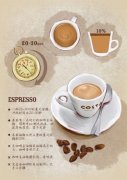
COSTA's "Golden Rule of Coffee" teaches you to distinguish between quality coffee.
The world consumes more than 4000 billion cups of coffee every year. There is no doubt that coffee has become one of the most popular drinks in the world. There are many types of coffee with different styles and methods, but the same thing is that every good cup of coffee can be a pleasant experience, while bad coffee can only spoil the mood. There is only a small difference in quality.

There are six steps in coffee cup evaluation.
There are six steps in coffee cup evaluation, describing the aroma, aroma, taste, smell, aftertaste and mellowness of coffee.

Interpretation of the name of coffee beans
Why do coffee beans have such a long name? Why is there a single item, deep roast and Italian style of coffee? How is this distinguished?

Can different varieties of coffee beans roasted in shallow, medium and deep degrees be blended?
In contrast to the blending technology school, the baking technology school believes that 80% of the taste of coffee depends on roasting. Regardless of the percentage data, whether you pay attention to the degree of baking or do-it-yourself baking, this has indeed become an important indicator to verify the identity of a coffee glutton. Roasting refers to roasting raw coffee beans with a special machine to make the coffee beans show a unique coffee color, aroma and taste.

Is Crema an important indicator of Espresso success or failure? What is Espresso like in Italy?
Professional coffee knowledge exchange more coffee bean information please follow the coffee workshop (Wechat official account cafe_style) espresso espresso _ espresso _ espresso a cup of standard Espresso is only about one ounce, and it is also covered with a fine layer of foam called Crema. Klima's foam is as detailed as possible, like a layer of colored cream.
The Secret in the label: interpreting the name of Coffee Bean
Why do coffee beans have such a long name? Why is there a single item, deep roast and Italian style of coffee? How is this distinguished?
Six steps that must be known in coffee cup evaluation
Cup review is the most common way to distinguish between good and bad coffee. Coffee cup evaluation mainly includes six aspects, namely, coffee aroma (Fragrance), aroma (Aroma), taste (Taste), smell (Nose), aftertaste (Aftertaste) and mellow (Body).
Coffee Spirit and Coffee Taste Index represented by coffe
Coffee spirit and coffee taste indicators Coffee spirit: Confident confident, Optimistic optimistic, Friendly friendly, Frank frank, Enthusiastic enthusiastic, coffee tasting 7 indicators: ① dry aroma Fragrance: roasted beans after grinding aroma ② wet aroma Aroma: aroma of coffee liquid ③ acidity ACidity: acid of coffee liquid
The name of the coffee bean.
Why do coffee beans have such long names? Why is coffee divided into single, deep roast and Italian? How is this distinguished? When you walk into a specialty coffee shop or open a website for a specialty coffee bean vendor, you may be confused by the variety of coffee names. Why do coffee beans have such long names? Why is coffee divided into single, deep roast and Italian? How is this divided?

coffee roasting| How to understand coffee roasting curve What does roasting curve help roast coffee
What is a baking curve? Why is it so important? Baking curves help monitor baking by tracking the heat in the drum at critical times throughout the baking process. By demonstrating how the same amount of heat can be applied simultaneously to a batch of products, they can help the oven create guidelines that reproduce the outline of the oven. Roasting curves can help identify and track the order coffee goes through during roasting
Small Roaster China Coffee Trading Network Fresh Roaster Delong Coffee Machine
Delong coffee machine cleaning points are as follows: 1, cleaning coffee grounds containing box, must be emptied first. 2, Delong coffee machine water tank needs regular cleaning 3, drip tray equipped with water level indicator buoy is red, can show the drip tray internal water storage situation, when the water level indicator buoy floats obviously visible, if necessary, available needles for dredging. 4, regular use of sponge cleaning

Professional course | definition of roasting degree of coffee beans
First, when judging the roasting degree of coffee beans, the degree of roasting can be judged by sound, color and aroma. Its color ranges from light gray to dark brown, and its aroma is gradually rich from light and elegant; the sound is made two times of bursting sound. Taking the heat-resistant raw bean as an example, the first explosion begins at about 7 minutes and lasts for about 2 minutes, and its voice is low. It indicates the beginning of pyrolysis, the conversion of starch to caramel and moisture.